Modern automotive scanners have become essential tools for mechanics, workshops, and even serious DIY car enthusiasts. As vehicles continue to evolve with advanced electronics, ECU systems, and integrated sensors, a simple code reader is no longer sufficient. Today’s best automotive scanner models go far beyond basic fault detection, offering full-system diagnostics, bi-directional control, ECU coding, and real-time live data graphing to support accurate and efficient troubleshooting.
With these advanced capabilities, technicians can quickly identify and resolve issues across engine, transmission, ABS, and airbag systems with greater precision. Whether used in a professional workshop or by experienced DIY users, the best automotive scanner provides a comprehensive solution for modern vehicle diagnostics, significantly improving repair efficiency, reducing diagnostic time, and ensuring more reliable maintenance outcomes.
Before comparing different diagnostic tools in detail, it is essential to understand the three main categories of automotive scan tools. Each category is designed for a different level of user, ranging from everyday car owners to professional automotive technicians. The differences mainly lie in system coverage, diagnostic depth, functionality, and overall cost.
Basic OBD2 code readers are the most entry-level diagnostic tools available on the market. They are primarily designed to read and clear engine-related fault codes from the vehicle’s ECU (Engine Control Unit). These scanners connect directly to the OBD2 port and can quickly identify issues such as emissions-related faults, engine misfires, oxygen sensor problems, or fuel system errors.
Because of their simplicity, they are highly affordable and very easy to use, often requiring only a plug-and-play operation without advanced setup. However, their functionality is limited strictly to the engine system. They do not provide access to other critical vehicle systems such as ABS (Anti-lock Braking System), SRS (airbag system), or transmission modules. In addition, they typically lack advanced features like live data streaming, freeze frame analysis, or bidirectional control. As a result, they are best suited for casual car owners who only need basic troubleshooting and quick error code checks.
Mid-range diagnostic scanners offer a significant upgrade in functionality and coverage. In addition to engine diagnostics, they typically support multiple vehicle systems such as ABS, SRS, transmission, HVAC, and sometimes even body control modules. This makes them more suitable for serious DIY users, small repair shops, and automotive enthusiasts.
These scanners often include advanced features like live data graphing, which allows users to monitor real-time sensor performance, and service reset functions such as oil reset, electronic parking brake (EPB) reset, and battery registration. Many models also support bi-directional control, meaning the user can send commands to the vehicle to test components such as fuel pumps, fans, or injectors.
Compared to basic code readers, mid-range scanners provide a much deeper understanding of vehicle health and are significantly more useful for diagnosing complex issues that go beyond simple engine faults.
Professional diagnostic tablets represent the highest level of automotive scanning technology. These devices are widely used in dealerships, repair workshops, and advanced automotive service centers. They offer full-system diagnostics across virtually all electronic control units in a vehicle, including engine, transmission, ABS, SRS, body systems, infotainment, and more.
In addition to comprehensive diagnostics, they support advanced functions such as ECU programming and coding, key programming, topology mapping (visual network layout of vehicle systems), and advanced bi-directional testing. Many also include online coding capabilities and manufacturer-level software access.
These tools are typically built on Android-based tablet platforms with large touchscreens, wireless connectivity, and regular software updates covering a wide range of vehicle brands. While they are significantly more expensive than other categories, their depth of functionality makes them indispensable for professional technicians who need accurate, fast, and complete diagnostic capabilities for modern vehicles.
Modern automotive diagnostic scanners are essential in today’s repair industry. As vehicles increasingly depend on ECUs, ADAS, and interconnected electronic modules, technicians require tools that go beyond basic OBD2 code reading. In the following section, we will introduce four high-quality automotive scanners, each offering advanced diagnostics, improved efficiency, and professional-grade performance for modern vehicle servicing needs.
The Launch X431 PAD VII Elite is widely regarded as one of the most advanced professional diagnostic platforms in the Launch ecosystem. It supports full-system OE-level diagnostics, bi-directional control, ECU coding, and ADAS calibration. Its intelligent topology mapping feature allows technicians to visualize vehicle communication structures, making fault tracing significantly faster and more accurate.
In real-world workshop environments, the PAD VII Elite stands out for its versatility. It supports a broad range of vehicles, including passenger cars and light commercial vehicles, and integrates advanced functions like key programming and service resets. Compared with mid-tier scanners, it offers deeper ECU access and faster processing, making it suitable for high-volume workshops.
The LAUNCH X431 PRO3S+ is a more cost-efficient alternative within the Launch lineup, but it still delivers strong professional capabilities. It supports full-system diagnostics, ECU coding, and active tests, making it highly effective for independent repair shops and advanced DIY users.
While it lacks some of the advanced visualization and ADAS-focused features of the PAD VII Elite, it compensates with an excellent balance between price and functionality. In comparison to the PAD VII, the PRO3S+ is more compact and easier to deploy, though slightly less powerful in heavy diagnostic and programming tasks.
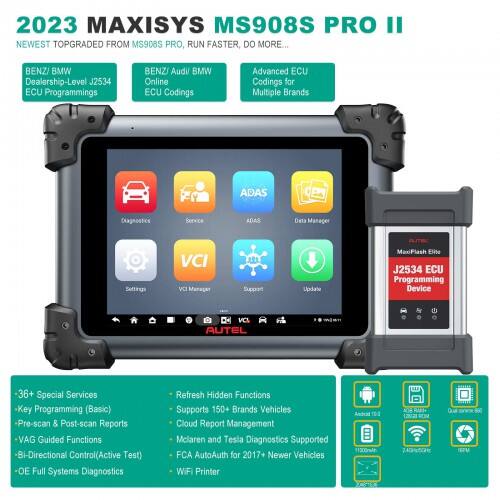
The Autel MaxiSYS MS908S PRO II is a flagship professional scanner designed for advanced automotive diagnostics and ECU programming. It offers OE-level full-system diagnostics, bi-directional control, and J2534 ECU programming support, making it highly suitable for dealership-level work and advanced independent workshops.
Compared to Launch devices, the MS908S PRO II is often praised for its strong ECU programming stability and deep OEM-level coverage across European and Asian vehicles. While the PAD VII Elite may provide more ADAS and topology visualization features, the Autel MS908S PRO II tends to excel in programming precision and module-level repair workflows.
The Autel MaxiSYS Ultra EV is designed for the future of automotive repair—especially electric and hybrid vehicles. It provides comprehensive EV battery diagnostics, high-voltage system analysis, ECU coding, and advanced topology mapping.
Compared to the MS908S PRO II, the Ultra EV adds significantly expanded EV capabilities and a more powerful diagnostic architecture. It is also more advanced than both Launch models in terms of EV system integration and future-proof diagnostic support. However, this extra capability comes with higher complexity and cost, making it best suited for dealership environments and specialized EV service centers.
Choosing the right automotive scanner depends on your workshop level, vehicle coverage needs, and required diagnostic depth. Among the four models—Launch X431 PAD VII Elite, LAUNCH X431 PRO3S+, Autel MaxiSYS MS908S PRO II, and Autel MaxiSYS Ultra EV—the main differences lie in system coverage, ECU programming strength, EV capability, and workflow efficiency.
For high-volume professional workshops handling multiple brands and complex repairs, the Launch X431 PAD VII Elite and Autel MS908S PRO II are strong choices. The PAD VII Elite is better suited for advanced topology mapping, ADAS calibration, and fast system visualization, helping technicians quickly locate faults in modern vehicles. In contrast, the MS908S PRO II is more focused on stable ECU programming and OE-level diagnostics, making it ideal for module replacement and precise reprogramming tasks where accuracy is critical.
For users seeking a more cost-effective professional tool, the LAUNCH X431 PRO3S+ offers a strong balance of performance and value. It supports full-system diagnostics, bi-directional control, and ECU coding, but at a lower price and with simpler operation. While it lacks advanced ADAS functions and topology visualization found in the PAD VII Elite, it remains highly efficient for routine repairs such as engine faults, ABS issues, and service resets.
For EV-focused or future-ready workshops, the Autel MaxiSYS Ultra EV is the most advanced option. It combines traditional diagnostics with deep EV battery analysis, high-voltage system testing, and advanced topology features. Compared to the other three models, it offers the broadest capability range, but also comes with higher complexity and cost, making it best suited for specialized or dealership-level environments.
The best automotive scanner models—Launch X431 PAD VII Elite, LAUNCH X431 PRO3S+, Autel MaxiSYS MS908S PRO II, and Autel MaxiSYS Ultra EV—each serve distinct professional needs within modern vehicle diagnostics. While they all provide full-system diagnostics, bi-directional control, and ECU coding, their true differences are defined by specialization, workflow design, and long-term adaptability to emerging automotive technologies. Some models prioritize advanced system visualization and ADAS calibration, while others focus on stable ECU programming, affordability, or cutting-edge EV diagnostic capabilities.
Ultimately, the best automotive scanner depends on your workshop’s direction and operational priorities. Whether your focus is efficiency and versatility, cost-effective professional performance, precise programming accuracy, or advanced electric vehicle servicing, each option offers a tailored solution. Selecting the right tool not only improves diagnostic accuracy but also enhances workflow efficiency, reduces repair time, and strengthens long-term competitiveness in an increasingly complex and technology-driven automotive industry.
Mar 17, 2026
Apr 06, 2026

 EN
EN