As electric vehicles continue to reshape the global automotive industry, Tesla has become one of the most influential leaders in this transformation. Known for its advanced software-driven architecture, Tesla vehicles are fundamentally different from traditional internal combustion engine cars. While this innovation brings improved performance, efficiency, and intelligent features, it also introduces new challenges in diagnostics and repair.
For workshops, technicians, and manufacturers of car diagnostic tools, understanding how Tesla diagnostic systems work is essential. A Tesla diagnostic tool is no longer just an optional accessory—it is a critical requirement for accurately maintaining, troubleshooting, and repairing Tesla electric vehicles (EVs). This article explores how Tesla diagnostic tools function, what makes Tesla diagnostics unique, and how modern diagnostic equipment helps professionals repair electric vehicles more efficiently.
Tesla vehicles are built on a highly integrated electronic and software ecosystem. Unlike conventional cars that rely heavily on mechanical systems, Tesla vehicles use a combination of electric drivetrains, battery management systems, advanced driver-assistance systems (ADAS), and over-the-air (OTA) software updates.
This shift means that traditional OBD-II scanners are no longer sufficient for deep diagnostics. While basic fault codes may still be accessible, most Tesla systems require advanced communication protocols and manufacturer-specific tools.
A Tesla diagnostic tool is designed to bridge the gap between complex vehicle systems and effective maintenance by enabling technicians to access high-voltage battery system data, read and clear Tesla-specific fault codes, perform detailed module-level diagnostics, calibrate advanced driver assistance system (ADAS) components, monitor real-time vehicle telemetry, and conduct firmware and software troubleshooting.
As Tesla continues to evolve its vehicle architecture with increasingly integrated and sophisticated electronic systems, diagnostic tools must also advance in capability and precision to keep pace, ensuring reliable maintenance, faster fault resolution, and optimal vehicle performance.
Tesla vehicles use a centralized electronic control architecture, which is different from traditional automotive systems. Instead of relying on multiple independent ECUs (Electronic Control Units) that operate separately, Tesla integrates many vehicle functions into a unified computing system. This architecture improves efficiency and performance but also makes diagnostics more complex, as multiple systems are tightly interconnected.
A Tesla diagnostic tool typically communicates with the vehicle through several key channels, including CAN bus networks (Controller Area Network), Ethernet-based communication systems, and Tesla’s proprietary diagnostic gateways. These communication pathways allow the tool to securely access and exchange data with the vehicle’s internal systems in real time.
Once connected, the diagnostic tool can interface with a wide range of vehicle subsystems such as the Battery Management System (BMS), drive inverter and motor controllers, thermal management system, Autopilot hardware, charging system including the onboard charger, and various body control modules. Because Tesla systems are highly software-driven, diagnostics go beyond simply reading fault codes—they often involve analyzing live data streams and following guided troubleshooting procedures to accurately identify and resolve issues.
A professional-grade Tesla diagnostic tool provides a wide range of capabilities that go far beyond standard scan tools. Some of the most important functions include:
Tesla vehicles generate Diagnostic Trouble Codes (DTCs) that are specific to their proprietary electronic and software systems. A Tesla diagnostic tool enables technicians to accurately read these codes, interpret their meaning, and trace them back to the affected subsystem. After repairs are completed, the tool also allows safe clearing of the fault codes to confirm that the issue has been resolved and that the system is operating normally again.
The battery pack is the most critical and valuable component in a Tesla vehicle, making its diagnostics essential for safety and performance. Advanced diagnostic tools can monitor individual cell voltages, evaluate overall battery degradation, assess thermal balance across the pack, and detect charging inconsistencies. This detailed information helps technicians ensure long-term battery health and prevent potential failures or efficiency loss.
Tesla electric motors are highly efficient and tightly controlled by software, which requires precise diagnostic capabilities. Through specialized tools, technicians can analyze motor performance, detect irregularities in torque output, and assess inverter behavior under different driving conditions. This helps identify performance issues early and ensures the drivetrain operates at optimal efficiency.
Tesla’s Autopilot and advanced driver assistance systems rely on a network of cameras, and in earlier models, radar and ultrasonic sensors. After repairs, replacements, or windshield changes, these systems often require recalibration. A diagnostic tool supports this process by enabling camera alignment, sensor recalibration, and system validation checks to ensure accurate perception and safe operation.
Tesla vehicles receive frequent over-the-air (OTA) updates that improve performance and add new features. However, service situations may require deeper software intervention. Diagnostic tools allow technicians to identify update failures, verify firmware versions, reset affected modules after updates, and ensure that all vehicle systems are properly synchronized after software changes.
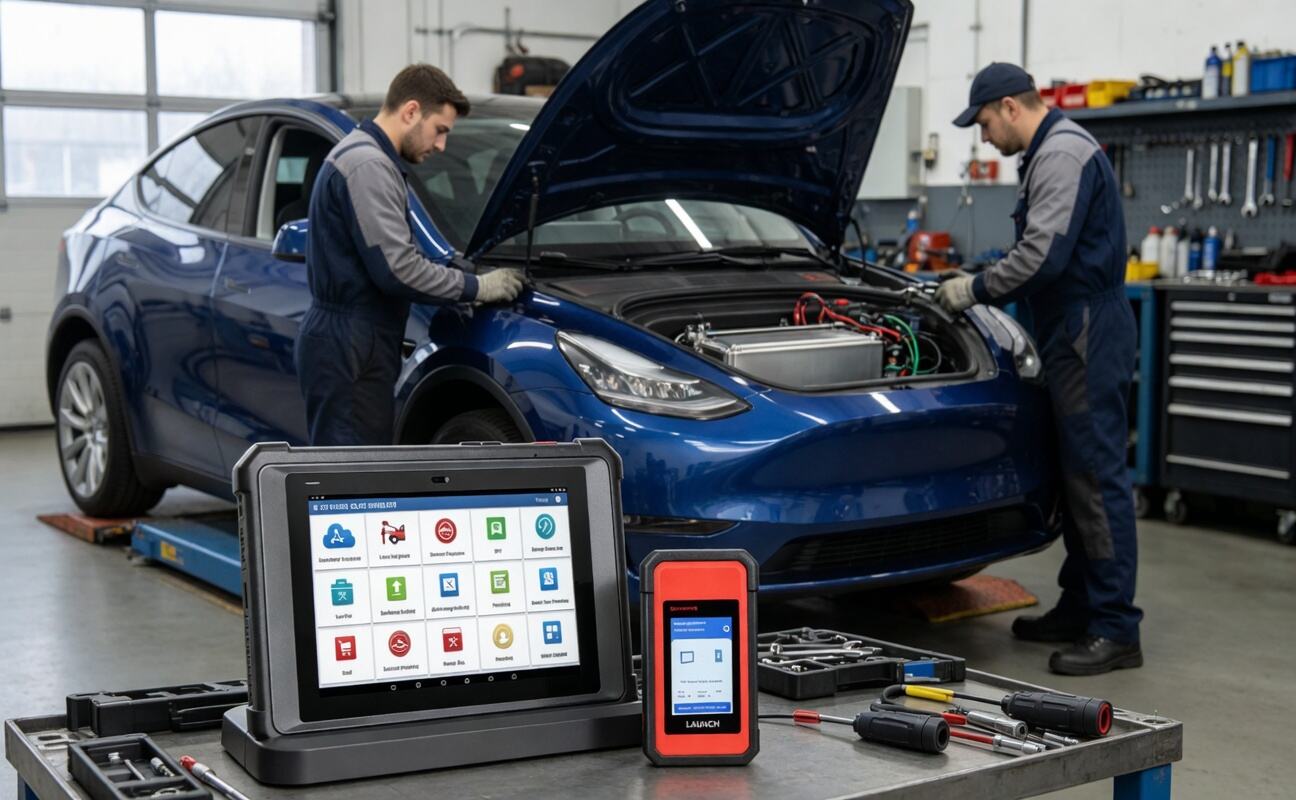
For professional repair shops, Tesla diagnostic tools are essential for delivering accurate, efficient, and reliable service, enabling technicians to quickly identify faults, perform advanced diagnostics, and ensure safe, high-quality maintenance and repair of complex electric vehicle systems. Common applications include:
Technicians rely heavily on Tesla diagnostic tools to evaluate the health of the high-voltage battery system and determine whether issues can be resolved through module-level repair or require full pack replacement. By analyzing cell balance, internal resistance, thermal behavior, and degradation patterns, the tool provides a clear picture of battery condition and supports accurate, cost-effective decision-making.
After a collision, even minor structural damage can affect the alignment of cameras, sensors, and other critical components used in Tesla’s driver assistance systems. Diagnostic tools are essential in the post-repair process, ensuring that all affected systems are recalibrated correctly. This includes verifying sensor positioning, restoring calibration parameters, and confirming that safety and autonomy features function as intended.
Tesla vehicles rely on a complex high-voltage and low-voltage electrical architecture, making fault isolation challenging without specialized tools. Diagnostic systems help technicians quickly identify issues related to charging systems, power distribution units, wiring faults, or control modules. By providing detailed error data and live system feedback, they significantly reduce troubleshooting time and improve repair accuracy.
Beyond reactive repairs, Tesla diagnostic tools also play a key role in preventive maintenance. By continuously analyzing real-time vehicle data, technicians can detect early warning signs of component wear, software irregularities, or system inefficiencies. This proactive approach helps prevent unexpected breakdowns, reduces long-term repair costs, and improves overall vehicle reliability.
For companies developing automotive diagnostic tools, Tesla represents both a significant challenge and a major opportunity. The rapid growth of electric vehicles has increased the demand for advanced diagnostic solutions that can handle high-voltage systems, software-defined architectures, and continuously evolving vehicle platforms.
In this context, key development considerations include ensuring compatibility with Tesla communication protocols, maintaining frequent software updates to match Tesla’s firmware changes, handling high-security data communication requirements, and designing intuitive interfaces that technicians can use efficiently in real-world service environments.
Kolsol is focused on delivering professional-grade automotive diagnostic solutions designed to meet the demands of modern electric and traditional vehicles. Our car diagnostic tools that support multi-brand compatibility, including Tesla-related systems, while continuously improving software adaptability and system coverage.
As Tesla continues to innovate, diagnostic tools will evolve alongside its increasingly software-driven vehicle architecture. Future developments are expected to incorporate AI-powered diagnostics, allowing systems to analyze complex vehicle data and predict potential failures before they occur. This shift toward intelligent analysis will significantly improve troubleshooting efficiency and help technicians address issues proactively rather than reactively.
In addition, the future of Tesla diagnostics is likely to be shaped by cloud-based platforms and deeper software integration. Technicians may rely more on cloud connectivity to access real-time vehicle data, remote manufacturer support, and advanced analytics. Remote diagnostics—already used internally by Tesla—may also become more widely available through third-party tools. Combined with tighter integration into Tesla’s software ecosystem, these advancements will enable more accurate calibration, faster repairs, and more efficient service workflows.
Tesla has fundamentally reshaped the automotive industry by turning traditional vehicles into advanced, software-driven machines. Unlike conventional cars, Tesla vehicles rely heavily on integrated electronics, real-time data processing, and continuous software updates. This transformation has significantly increased the importance of advanced diagnostic solutions capable of interpreting complex vehicle systems.
A Tesla diagnostic tool is far more than a basic fault code reader. It functions as a comprehensive platform that allows technicians to access vehicle data, analyze system performance, identify hidden issues, and perform precise repairs across electric powertrains, battery systems, autopilot modules, and onboard software. As Tesla technology continues to evolve, the need for specialized diagnostic equipment becomes even more critical.
For repair shops, Tesla diagnostic tools ensure accuracy, efficiency, and safety in vehicle servicing and troubleshooting. For manufacturers, they represent a rapidly growing market opportunity driven by the global shift toward electric mobility, increasing demand for advanced diagnostics, and continuous innovation in electric vehicle technology and intelligent automotive systems today.
Mar 17, 2026
Apr 09, 2026

 EN
EN